
Baidyanath Dham is one of the most sacred pilgrimage sites in India. It stands in Deoghar, Jharkhand. Devotees believe Lord Shiva resides here as one of the twelve Jyotirlingas. At the same time, the presence of Goddess Shakti makes this temple even more powerful. Therefore, Baidyanath Dham represents the eternal union of Shiva and Shakti.
For centuries, pilgrims have traveled long distances to seek blessings at Baidyanath Dham. Many come with prayers for healing. Others seek peace, strength, and liberation. According to legend, Ravana worshipped Lord Shiva here with intense devotion. As a result, the temple holds a special place in Hindu mythology.
Moreover, the name Vaidyanath means the Divine Healer. Devotees believe that sincere prayers offered here remove suffering and grant inner strength. The temple complex remains vibrant throughout the year. During Shravan, the energy of faith fills every corner of Deoghar.
Thus, Baidyanath Dham is not just a temple. It is a living center of devotion where mythology, faith, and spiritual power come together. In the following sections, we will explore its history, legends, rituals, and deeper significance.
Jyotirlinga: Pillar of Light & Divine Tale
According to the Shiva Purana, once Brahma, the god of creation, and Vishnu, the god of preservation, argued about who was greater. To settle this, Lord Shiva appeared as a huge, endless pillar of light, called the jyotirlinga, which stretched across the three worlds. Brahma went upward on a swan to find the top, while Vishnu went downward, taking the form of a boar, to find the bottom.

Vishnu honestly admitted he could not find the end of the light, but Brahma lied, saying he had reached the top and even showed a ketaki flower as false proof. Shiva became angry at Brahma’s dishonesty and cursed him so that he would never be worshipped, while Vishnu would be worshipped forever for his truthfulness. The jyotirlinga temples are believed to be the places where Shiva appeared as this infinite column of light.
Each of the 12 Jyotirlinga temples marks a point where Shiva chose to appear. The tradition highlights both his boundless power and his intimate presence across the land.
Legend of Baidyanath Dham
According to legend, Ravana performed intense penance in the Himalayan region to please Lord Shiva. To prove his devotion, he offered nine of his heads to Shiva. When he prepared to sacrifice his tenth head, Lord Shiva appeared before him. Shiva expressed his satisfaction and asked Ravana to seek a boon.
Ravana requested the Kamna Linga and wished to carry Lord Shiva from Mount Kailash to Lanka. Shiva agreed to this request but placed a strict condition. He warned that if Ravana placed the lingam anywhere on the way, it would become Shiva’s permanent abode and could never be moved.
Meanwhile, the celestial gods grew worried. They feared Shiva’s departure from Mount Kailash. Therefore, they approached Lord Vishnu for help. Vishnu then instructed Varuna, the god of water, to enter Ravana’s body during achamana, the ritual of sipping water. As a result, Ravana felt a strong urge to relieve himself while passing through the region of present-day Deoghar.
At this point, Vishnu took the form of a shepherd named Baiju Gadariya. Ravana asked him to hold the lingam while he performed Surya Namaskar. However, due to Varuna’s influence, Ravana took a long time to return. Eventually, Baiju lost patience. He placed the lingam on the ground and left the spot.
When Ravana returned, he tried to lift the lingam. He failed. Soon, he realized that Lord Vishnu had intervened. In anger and frustration, Ravana pressed his thumb against the lingam before leaving. This act caused a slight damage, which devotees believe remains visible even today.
Later, Brahma, Vishnu, and other gods began worshipping the lingam at that very place. They established the Baidyanath Temple there. Since then, Lord Shiva has resided in Deoghar as Vaidyanath, the divine healer and the embodiment of the Kamna Linga.
The Shakti Peetha: A Symbol of Divine Power
According to the Hindu Puranas, Sati, the daughter of Prajapati Daksha, married Shiva against her father’s wishes. Daksha performed a grand yajna (sacrifice) but did not invite Sati or Shiva. Even so, Sati went to the yajna, where Daksha ignored her and insulted Shiva. Unable to bear the insult, Sati offered herself into the fire. Filled with grief, Shiva wandered the universe carrying her half-burnt body. At last, Vishnu used his Sudarshan Chakra to cut her body into 51 parts, which fell on different places across the earth. Each of these places became Shakti Peethas.
In Deoghar, devotees believe that Sati’s heart fell at this sacred spot. As a result, the site became the Hriday Peeth, or the Heart Shrine. The Shakti Peetha here honors Jaya Durga, a powerful form of Goddess Parvati.
Historical Journey of Baidyanath Temple
The Matsya Purana refers to this sacred place as Arogya Baidyanathitee, which means the land of healing. Over time, the region of Deoghar came under the rule of the Kings of Gidhaur. These rulers showed deep devotion to Baidyanath Dham and supported the temple’s growth and rituals. Raja Bir Vikram Singh founded the Gidhaur princely state in 1266.
Centuries later, political control in Bengal changed. In 1757, after the Battle of Plassey, the East India Company began expanding its influence. Soon, Company officials turned their attention toward Baidyanath Dham due to its importance and large pilgrim offerings.
The British administration sent an English officer named Keating to examine the temple’s management. Mr. Keating served as the first English Collector of Birbhum. He took a keen interest in overseeing the temple’s administration. In 1788, he directed his assistant, Mr. Hesilrigg, to personally supervise the collection of pilgrim offerings and dues. Historical accounts suggest that Mr. Hesilrigg became one of the first Englishmen to visit the holy city.
However, when Mr. Keating later visited Babadham himself, he reconsidered his approach. He realized the deep religious sensitivity attached to the temple. As a result, he withdrew from direct interference. He restored full administrative control to the temple’s high priest.
The Havan Kund temple at Baba Dham opens only once a year. This opening takes place during Navratri and follows a special sacred tradition.
Architecture of Baidyanath Dham Temple
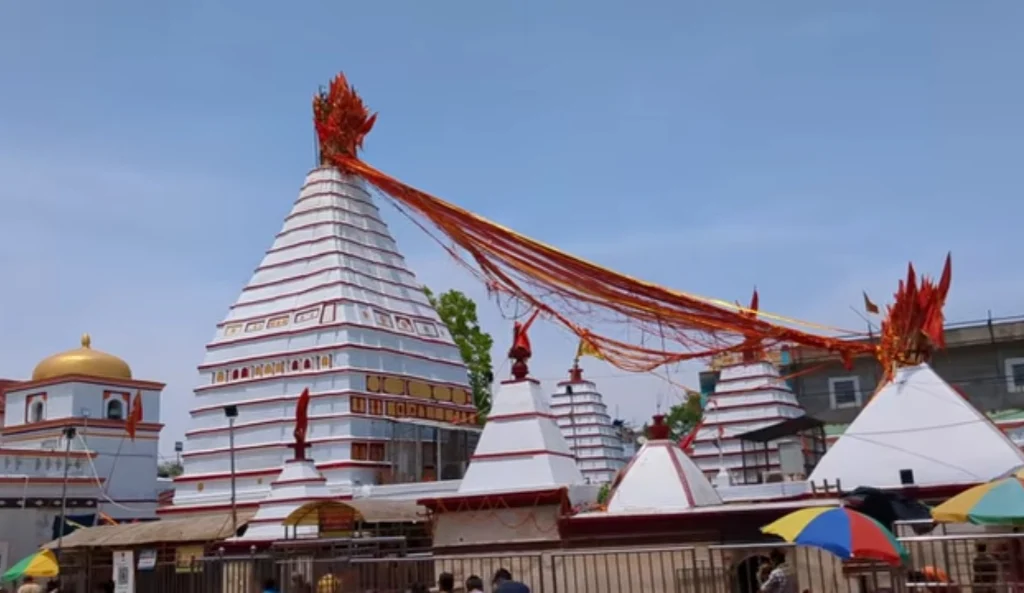
The temple follows the late medieval Nagara style of architecture. A curving shikhara rises to a height of 72 feet. Regional influences shape its pyramidal form and lotus-like appearance. A gold kalasha crowns the tower. Above it sit the pancha shula trident and the chandrakanta mani jewel.
The builders used load-bearing masonry for strength. They arranged stone courses in a corbelled pattern to ensure stability. Laterite forms the core structure, while sandstone covers the exterior with finely carved details.
Key Structural Features
The main sanctum, or garbhagriha, houses the black stone Jyotirlinga on a granite base. Only male devotees may enter the sanctum to perform abhishekam rituals. Thick walls of stone and laterite support the superstructure. Skilled craftsmen used precise joinery, including stone dowels, to ensure durability without arches.
The temple faces east. At its pinnacle, three ascending gold vessels rise above the structure. Local rulers donated these sacred offerings.
Temple Complex
The temple complex includes a total of 22 shrines. These include the main Baba Baidyanath temple and several smaller temples dedicated to different deities. These shrines honor deities such as Parvati, Ganesh, and Kali. Over the centuries, builders added courtyards and gateways around them.
Historical records link the early structures to periods between the 8th and 16th centuries. Rulers such as Raja Puran Mal supported its development. Through continuous patronage, the complex gradually expanded.
The builders used local materials and traditional techniques. The architecture reflects Eastern Indian temple styles. In some places, subtle tribal motifs add regional character.
Geographical Location of Baidyanath Dham
Baidyanath Dham, also known as Baba Dham, stands in the town of Deoghar in the Santhal Parganas division of Jharkhand. It lies within Deoghar district, about 243 km from the state capital, Ranchi. roughly 108 km from Sultanganj, from where pilgrims bring Ganges water. As one of the revered Jyotirlinga sites, the temple draws millions of devotees every year.
Here’s a quick overview:
| Aspect | Details |
|---|---|
| Coordinates | 24°29′33″N, 86°42′00″E |
| State | Jharkhand |
| District / Town | Deoghar |
| Elevation | 247 to 254 meters (833 feet) above sea level |
How to Reach Baba Baidyanath Temple
Travelers can reach Baidyanath Dham in Deoghar, Jharkhand, by air, rail, or road. The temple stands in a central location within the town. Moreover, local transport remains easily available for visitors.
By Air
Deoghar Airport (DGH) is the nearest airport, located about 3 to 5 km from the temple. IndiGo operates direct flights from Delhi, Kolkata, Mumbai, and Bengaluru. From the airport, you can take a prepaid taxi, which usually costs ₹300 to ₹500 and takes about 20 to 30 minutes. You may also hire an auto-rickshaw.
Alternatively, travelers can fly to Ranchi’s Birsa Munda Airport, about 250 km away, or Patna Airport, located around 110 km from Deoghar.
Railways
Jasidih Junction, about 7 km from the temple, serves as the main railway station. It connects Deoghar with major cities such as Delhi, Kolkata, Patna, Ranchi, and Varanasi. Popular trains on this route include the Patliputra Express and the Ranchi–Deoghar Special.
Deoghar Railway Station lies closer, at a distance of about 3.5 km. From either station, travelers can use auto-rickshaws, e-rickshaws, or taxis. The journey usually takes 15 to 20 minutes and costs between ₹100 and ₹200.
By Road
Deoghar Bus Stand lies about 2 km from the temple. State-run buses operate regularly from Patna, Ranchi, Kolkata, and Dhanbad. Travel time from Patna usually takes 7 to 8 hours, with fares between ₹300 and ₹500. Buses from Ranchi take 6 to 7 hours and cost around ₹250 to ₹400. From Kolkata, the journey lasts 9 to 10 hours, with fares ranging from ₹600 to ₹900. Buses from Dhanbad take about 3 to 4 hours.
Travelers can also hire private taxis or use app-based cabs such as Ola and Uber. National Highway 114 provides good road connectivity with major cities. From Kolkata, the drive covers about 280 km. During the Shravani Mela, it is advisable to book transport in advance.
Stay options near Baidyanath Dham in Deoghar
Baidyanath Dham in Deoghar, Jharkhand, offers many stay options for pilgrims. Visitors can choose budget dharamshalas and ashrams or opt for comfortable hotels. Many of these accommodations lie within 200 meters to 1 km of the temple, which allows easy and quick access for devotees.
Top Hotels
These mid-range hotels provide modern amenities like AC rooms, restaurants, and parking.
Budget Dharamshalas & Ashrams
Several affordable pilgrim lodgings operate near Baidyanath Dham. Most offer basic AC and non-AC rooms, along with dormitory facilities. Temple trusts manage many of these properties. During major festivals, especially Shravani Mela, you should book in advance.
Here are some convenient options:
- Yogmaya Niwas Ashram – Located about 800 meters from the temple. It offers 2 to 4 bed AC and non-AC rooms near Shiv Ganga.
- Baba Dham Yatri Niwas – Just 200 meters away. It provides 2 to 3 bed AC and non-AC rooms.
- Parvati Kutir – Around 300 meters from the temple. It offers 2 to 7 bed non-AC rooms and dormitories near Shiv Ganga.
- Hotel Nageshwaram Darshnam Inn – About 600 meters away. It provides 2 to 4 bed AC and non-AC rooms.
- Shankar Lodge – Located 230 meters from the temple. It offers 2 to 5 bed non-AC rooms.
Room rates start from approximately ₹277 per night on booking platforms such as Goibibo and MakeMyTrip. For dharamshala reservations, you may also check YatraDham.org.
Places of attraction near Baidyanath Dham
Popular sites emphasize spirituality, nature, and history, best visited October to March.
Shravani Mela: A Celebration of Faith
The Shravani Mela takes place during the Hindu month of Shravan, usually in July and August. During this period, lakhs of Kanwarias undertake a sacred journey to Baidyanath Dham. Their devotion fills the streets with chants of “Bol Bam.” As a result, Deoghar transforms into a vibrant and powerful center of faith.
The Kanwar Yatra forms the heart of the Shravani Mela. It reflects deep and unwavering devotion. During this sacred journey, Kanwarias walk nearly 105 kilometers from Sultanganj to Baba Baidyanath Dham. Many complete the trek barefoot as an act of faith.
They carry decorated kanwars made of bamboo and covered with colorful cloth. These structures hold holy water collected from the Ganga River. As they walk, devotees chant “Bol Bam,” which means “Hail Shiva.” Through this demanding journey, they show remarkable physical endurance and strong spiritual determination.
The Shravani Mela goes beyond the physical journey of the Kanwar Yatra. It reflects core Hindu values such as sacrifice, self-discipline, and unwavering faith. Devotees believe that offering holy Ganga water at the Baba Baidyanath Jyotirlinga brings great spiritual rewards. They trust that this sacred act removes sins, fulfills wishes, and invites the blessings of Lord Shiva.
If you plan to experience the Shravani Mela firsthand, prepare well in advance. During this period, Deoghar sees a massive rise in visitors. As a result, accommodations fill up quickly and basic amenities face heavy demand. Even so, witnessing the deep devotion and powerful spiritual energy makes the journey truly unforgettable.
Conclusion
Baidyanath Dham is not just a destination on the map. It is a living space of faith where devotion, mythology, and spiritual energy come together. Here, the presence of the Jyotirlinga and the Shakti Peetha creates a rare union that devotees experience not only through rituals but also through belief and surrender.
From ancient legends of Ravana to the tireless footsteps of Kanwarias during the Shravani Mela, Baidyanath Dham continues to inspire generations. Every prayer offered, every drop of Ganga water poured, and every chant of “Bol Bam” reflects a deep human connection with the divine. The temple stands as a reminder that faith can heal, guide, and transform lives.
Whether you visit Baidyanath Dham seeking healing, fulfillment of wishes, or inner peace, the journey leaves a lasting impression. Long after you leave Deoghar, the sense of devotion and spiritual calm remains with you. In that silence of the heart, Baidyanath Dham continues to call devotees back, again and again.
Frequently Asked Questions (FAQs)
The temple typically opens at 4:00 AM and closes at 9:00 PM.
General entry is free.
It usually takes 30 minutes to 1 hour on regular days, but can extend to 3–7 hours during festivals like Shravan Mela or Maha Shivratri.
Yes, “Quick Darshan” tokens are often available (historically around ₹200–₹500) to reduce waiting time to approximately 30–40 minutes.
The ideal weather is during the winter months, from October to March.