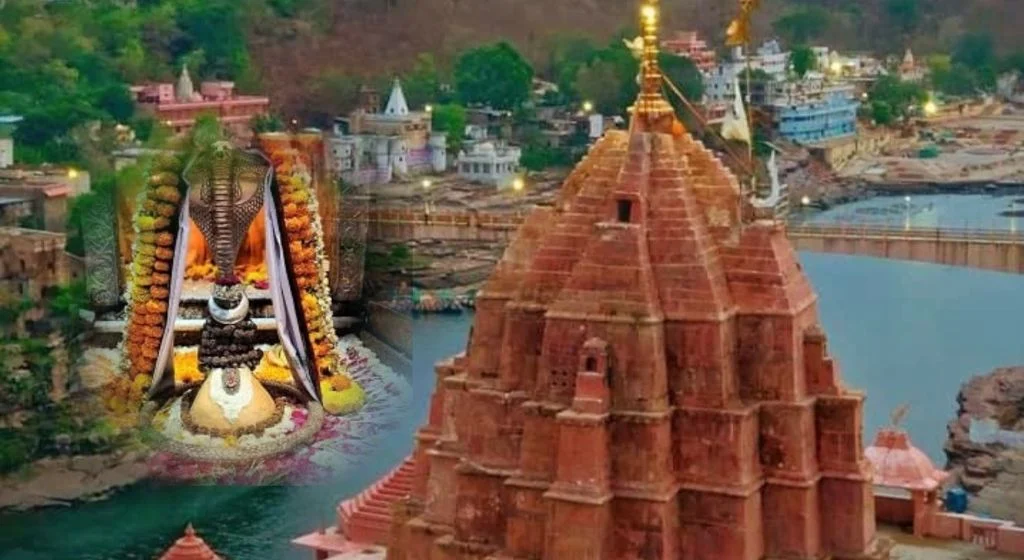


The sacred Omkareshwar Jyotirlinga stands on Mandhata Island in the Narmada River. The island forms the symbol “ॐ,” which makes this place unique and powerful. Devotees travel from across India to seek blessings and peace here.
The temple town feels alive. Bells ring across the ghats. Priests chant mantras. The river flows around the island like a divine embrace. The atmosphere feels calm yet deeply spiritual.
Legends say Lord Shiva appeared here to protect his devotees. These stories still inspire faith and devotion today. Travelers admire the temple’s heritage, river views, and scenic pathways.
Whether you seek divinity, history, or a peaceful getaway, Omkareshwar Jyotirlinga offers a rare spiritual experience. It connects belief, nature, and culture in one sacred space.
Pillar of Light & Divine Tales
According to the Shiva Purana, once Brahma, the god of creation, and Vishnu, the god of preservation, argued about who was greater. To settle this, Lord Shiva appeared as a huge, endless pillar of light, called the jyotirlinga, which stretched across the three worlds. Brahma went upward on a swan to find the top, while Vishnu went downward, taking the form of a boar, to find the bottom.
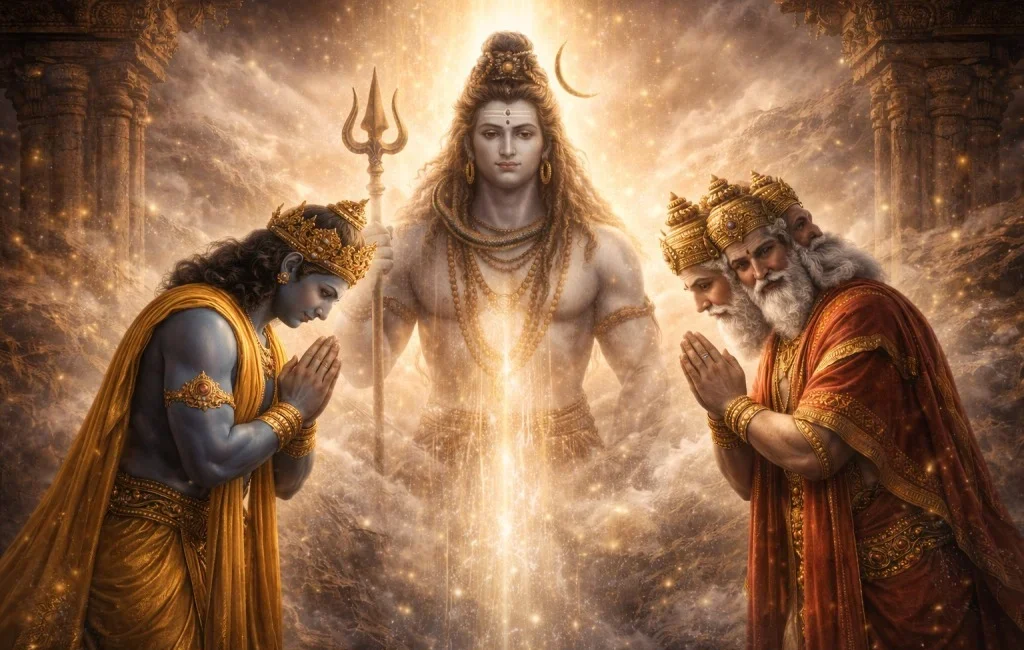
Vishnu honestly admitted he could not find the end of the light, but Brahma lied, saying he had reached the top and even showed a ketaki flower as false proof. Shiva became angry at Brahma’s dishonesty and cursed him so that he would never be worshipped, while Vishnu would be worshipped forever for his truthfulness. The jyotirlinga temples are believed to be the places where Shiva appeared as this infinite column of light.
Each of the 12 Jyotirlinga temples marks a point where Shiva chose to appear. The tradition highlights both his boundless power and his intimate presence across the land.
Legends of Omkareshwar Jyotirlinga
Omkareshwar is the fourth Jyotirlinga among the twelve Jyotirlingas of Bhagwan Shiva. Ancient texts like the Skanda Purana, Shiva Purana, and Vayu Purana mention its glory. The Omkareshwar Jyotirlinga stands on the northern bank of the Narmada River in Madhya Pradesh, about 77 km from Indore. It is the only Jyotirlinga located on the northern side of the river.
People believe that Bhagwan Shiva travels across the three worlds every day and then rests here. Because of this belief, the temple arranges special resting rituals. Devotees also get to see the Shayan Darshan of Bhagwan Shiva here.
Legend of Vindhya
According to Hindu legend, Vindhya, the deity of the Vindhyachal mountains, worshipped Bhagwan Shiva to cleanse his sins. He made a sacred geometric diagram and created a Lingam from sand and clay. Shiva became pleased with his devotion and appeared in two forms: Omkareshwar and Amaleswara.
People say the Lingam looked like the symbol “Om,” so the island got the name Omkareshwar. The temple also has shrines dedicated to Parvati and Ganapati.
Legend of King Mandhata
Another legend speaks about King Mandhata and his sons. King Mandhata belonged to the Ikshvaku clan and was an ancestor of Lord Ram. He worshipped Bhagwan Shiva here until Shiva appeared as a Jyotirlinga.
Some scholars also tell a similar story about Mandhata’s sons, Ambarish and Muchukunda. They performed strict penance and austerities here and pleased Shiva. Because of these legends, the mountain is known as Mandhata.
Another legend tells about a great war between the Devas (gods) and Danavas (demons). In this battle, the Danavas won. The defeat shocked the Devas, so they prayed to Bhagwan Shiva for help. Shiva became pleased with their prayers and appeared as the Omkareshwar Jyotirlinga. He then defeated the Danavas.
Historical Journey of Omkareshwar Jyotirlinga Temple
Advait Mat teaches that Omkaar is made of two parts: Om (sound) and Akaar (creation). Advait means “not two,” so both are seen as one, not separate. Om is the seed mantra of creation and is itself the source of all creation.
People say that Omkareshwar is the place where Adi Shankara met his guru Govinda Bhagavatpada in a cave. This cave still exists today, just below the Shiva temple. Inside, there is an image of Adi Shankara installed for devotees to see.
The Paramara Kings of Malwa built the temple in the 11th century CE. After them, the Chauhan rulers took over the temple’s administration. In the 13th century CE, the temple faced attacks and loot by Muslim invaders, starting with Mahmud Ghazni. However, the temple survived and was not completely destroyed.
During the Mughal period, the temple remained under the Chauhan rulers. They did not make any major repairs or renovations. In the 18th century, the Holkar rulers rebuilt the temple. Gautama Bai Holkar, the first Holkar Queen, started the reconstruction. Later, her daughter-in-law Devi Ahilyabai Holkar completed it.
During the colonial era, the temple came under British rule. After Independence in 1947, the Archaeological Survey of India (ASI) took responsibility for the temple with support from the Khandwa administration.
Architecture of Omkareshwar Jyotirlinga Temple
The Omkareshwar Jyotirlinga temple shows the beauty of Nagara-style architecture. Builders used soft, carved sandstone to construct it. The temple has five floors and a tall, distinct shikhara (spire). The walls include fine and detailed carvings.
The temple also mixes old and new construction styles. It has pillared halls, multi-layered designs, and polygonal shapes. These sections house multiple deities inside the complex.
Structure : The temple follows the Nagara style of North India. Its design includes a tall, tapering shikhara (spire) above the sanctum.
Layout : The temple features a five-story layout. Every floor houses a different form of Lord Shiva, including Omkareshwar, Mahakaleshwar, Siddhnath, Gupteshwar, and a shrine on the top floor.
Mandapa (Assembly Hall): The assembly hall is 14 feet tall and spacious. It rests on 60 huge pillars, each decorated with intricate carvings.
Material and Carvings: The temple is built from soft stone, which makes intricate carving possible. The outer walls show deities and scenes from the Puranas in rich detail.
Sanctum (Garbhagriha): The sanctum follows an older design, with a compact, layered stone dome. It sits slightly off-axis, so it may not align perfectly with the main entrance.
Unique Design Aspects: The temple shows a different design from many traditional Hindu temples. Some sections do not include pillared halls. The sanctum is small, old in style, and sometimes feels like a cave.
Surroundings: The temple surroundings include spacious verandas. Their columns form circular, polygonal, and square layouts.
Geographical Location of Omkareshwar Jyotirlinga
The Omkareshwar Jyotirlinga sits on Mandhata Island, also known as Shivpuri, in Khandwa district, Madhya Pradesh. The island rests at the holy meeting point of the Narmada and Kaveri rivers.
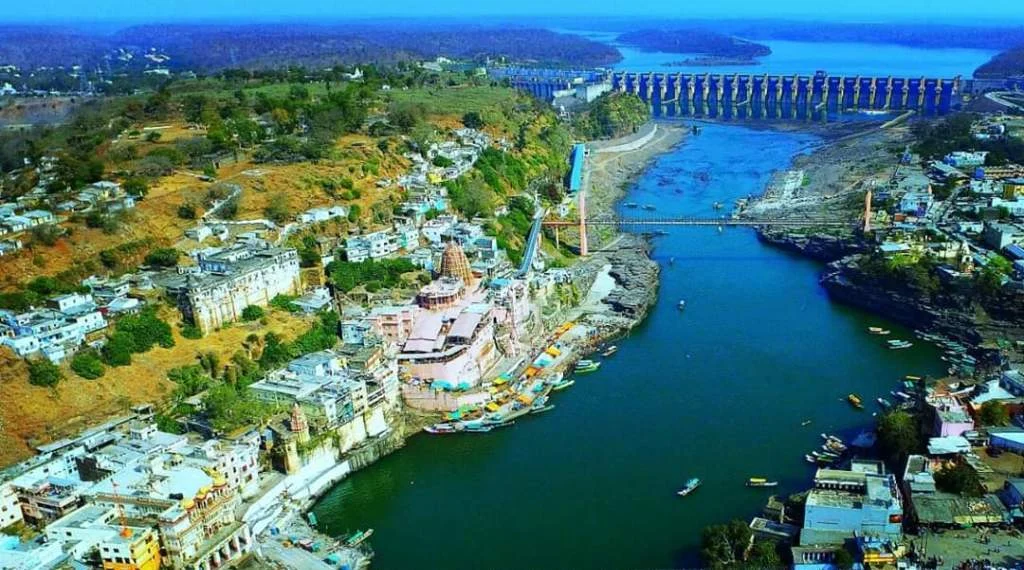
Here’s a quick overview:
| Aspect | Details |
|---|---|
| Coordinates | 22°14′44.1″N, 76°09′03.8″E |
| State | Madhya Pradesh, India. |
| District | Khandwa |
| River | Narmada and Kaveri |
| Island | Mandhata Island |
| Elevation | ~111 meters (364 ft) above sea level |
How to Reach Omkareshwar Jyotirlinga Temple

Fly into Indore (IDR) to start your journey. Take a train to Omkareshwar Road (OM) or Khandwa (KNW). Then use a taxi, bus, or local transport to reach the island town. Walk across Jhula Pul to enter the main shrine.
For faster entry, book special darshan online. Do not miss the Mamleshwar Temple on the opposite bank.
Nearest Airport:
Devi Ahilyabai Holkar Airport (IDR) in Indore, about 77 km away.
Nearest Railway Station:
Omkareshwar Road (OM): The nearest station, about 12 km away. It mainly serves local and regional trains.
Khandwa Junction (KNW): A major rail hub, 75–77 km away, with better long-distance connections. Taxis and buses are available from here.
Bookings: Consider booking special darshan (fast-track entry) online through the official temple website.
Best Time to Visit Omkareshwar Jyotirlinga Temple
| Season | Months | Weather | Crowd | Why visit now | Quick tip |
| Winter | Oct — Mar | Days are cool with gentle sunshine, while nights turn cold. | Busy (peak) | Great for peaceful darshan, riverside walks, and festival celebrations. | Plan your stay in advance. Visit the temple early for a calm and quiet darshan. |
| Summer | Apr — May | The weather is hot and dry. Temperatures can rise a lot. | Low | If you can handle the heat, mornings are okay. You get less crowd and cheaper hotels. | Wear light clothes. Drink plenty of water. Avoid going out at noon. |
| Monsoon | Jun — Sep | Expect heavy monsoon rains, and the river rises during this time. | Low to medium | The landscape turns lush and green. Tourist crowds drop. It’s perfect for photos if you enjoy rainy weather. | Expect slower travel. Always check weather conditions and boat services in advance. |
Stay options near Omkareshwar Jyotirlinga Temple

Hotel JOSHI INN
The property sits in Godarpura, around 80 km from Devi Ahilya Bai Holkar Airport. It lies on the Omkareshwar–Mortakka–Mundi Road. You can also visit the Indore Museum and the ISKCON Temple, which are nearby.
Govind Palace Restaurant and Resort
Govind Palace Restaurant and Resort in Barwah is located about 65 km from Devi Ahilya Bai Holkar Airport. The property offers free on-site private parking, and Alka Park sits just opposite, providing guests with additional leisure options.
Rituals and Daily Puja Schedule at Omkareshwar
For a hassle-free experience, visitors are advised to check the temple schedule before planning their visit.
- 04:30 AM to 05:00 AM – Mangal Aarti and Naivedya Bhog
- 05:00 AM to 12:20 PM – Mangal Darshan
- 12:20 PM to 01:15 PM – Madhyanha Bhog
- 01:15 PM to 04:00 PM – Madhyanha Darshan
- 04:00 PM to 04:15 PM – Sayamkalin Shringar
- 04:15 PM to 08:00 PM – Shringar Darshan
- 08:30 PM to 09:00 PM – Shayan Shringar and Aarti
- 09:00 PM to 09:30 PM – Shayan Shringar Darshan
Note: Temple authorities may restrict items like Bilvapatra, flowers, and coconuts inside the garbhgriha. Festival days and special occasions may also affect worship and darshan timings.
Places of attraction near Omkareshwar
Mamleshwar Temple
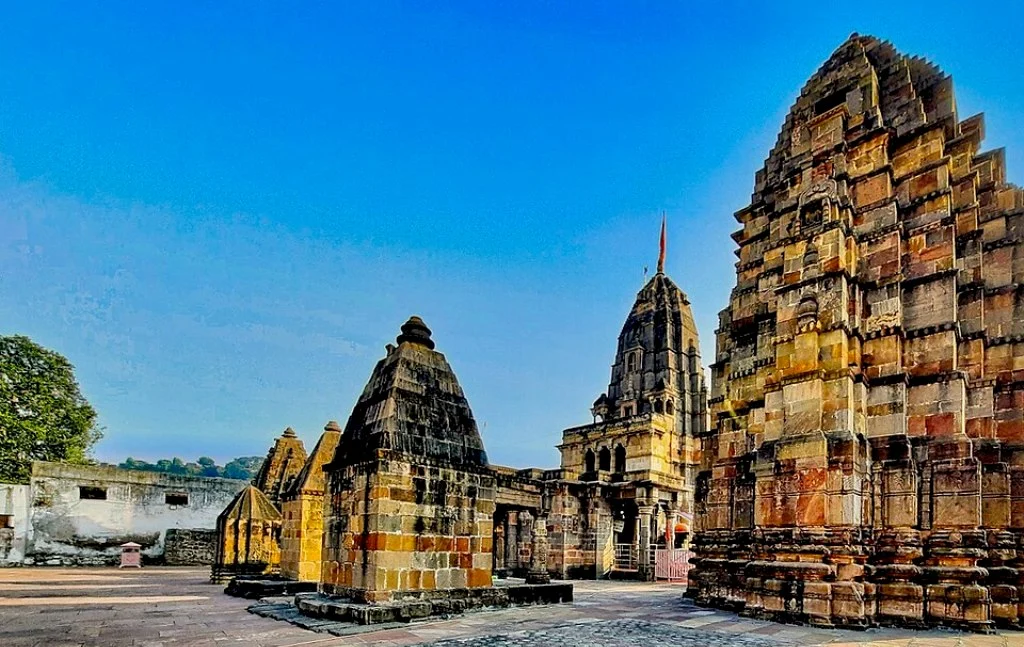
Visit Mamleshwar Temple (Amreshwar) on the southern bank of the Narmada River in Omkareshwar, Madhya Pradesh. This 12th-century shrine pairs with the Omkareshwar Temple across the river, and devotees consider darshan at both temples essential to complete the Jyotirlinga pilgrimage. Locals believe Nakula, one of the Pandava brothers, built the temple during their exile.
Narmada River Boat Ride
Take a Narmada boat ride in Omkareshwar for a 10 km, one-hour circuit around the holy OM-shaped island. The route passes ancient temples and the Narmada–Kaveri Sangam. Boats operate daily between 6:00 AM and 8:00 PM. Shared rides cost ₹20–₹50, while private boats cost ₹200–₹400.
Gauri Somnath Temple
Gauri Somnath Temple stands 1 km from Omkareshwar Temple and 2 km from the Omkareshwar Bus Station on Mandhata Island. It is a major Hindu shrine and one of the largest temples in Omkareshwar. Many travelers include it among the top places to visit during an Omkareshwar trip.
Conclusion
Omkareshwar Jyotirlinga is more than a temple. It is an island of faith and stories. The Narmada flows quietly around it. Devotees walk, pray, and reflect. The chants echo through the stone halls. The sunsets paint the water in gold. You feel peace without trying. If you love spiritual travel, add Omkareshwar to your list. The experience stays with you long after you leave.
Frequently Asked Questions (FAQs)
Normal darshan is free and does not need booking. Shighra Darshan tickets are available for quicker access.
Yes, you can book tickets online through the official website.
There is no official dress code. Wear regular and modest clothes.
You can book through the temple. Priests perform the rituals on behalf of devotees, and prasad is given after the puja.
Shri Ji Vishramalaya provides community halls for stay. For private rooms, reach out to Bhakt Niwas or Hotel Temple View.
Ujjain lies 140 km from Omkareshwar. Private cars and buses are available. Buses via Indore usually run until 7:00 PM or later.
A weekly procession begins from Koti Tirth Ghat every Monday. The royal version happens in the month of Shravan. You can sponsor it online.
Carry a printed ticket and a photo ID such as Aadhaar.