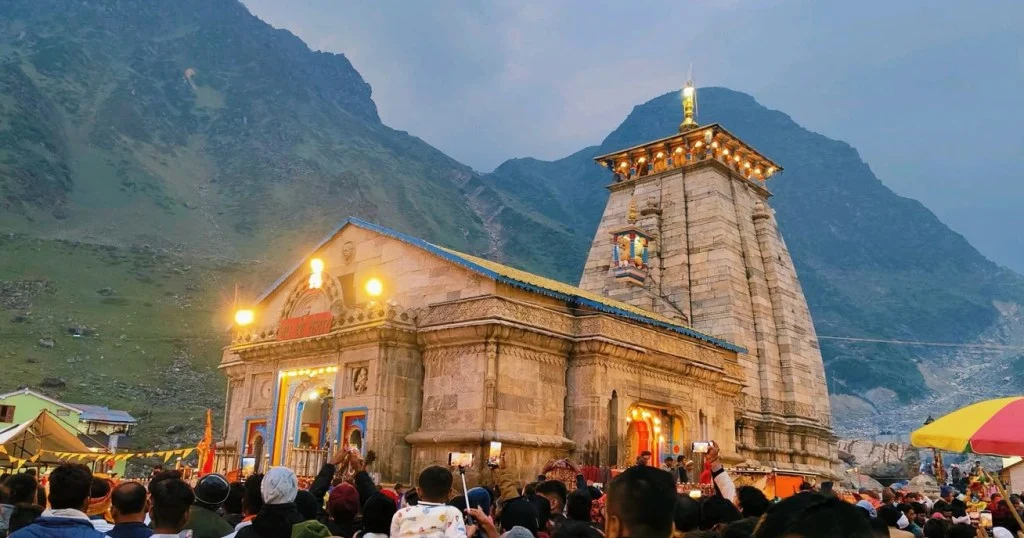


Kedarnath Temple is one of the most sacred pilgrimage sites in northern India. It stands on the banks of the Mandakini River at an altitude of 3,584 meters above sea level. People historically called the region Kedar Khand. The temple is part of both the Char Dham Yatra and Panch Kedar in Uttarakhand and is also one of the 12 Jyotirlingas of Lord Shiva in India.
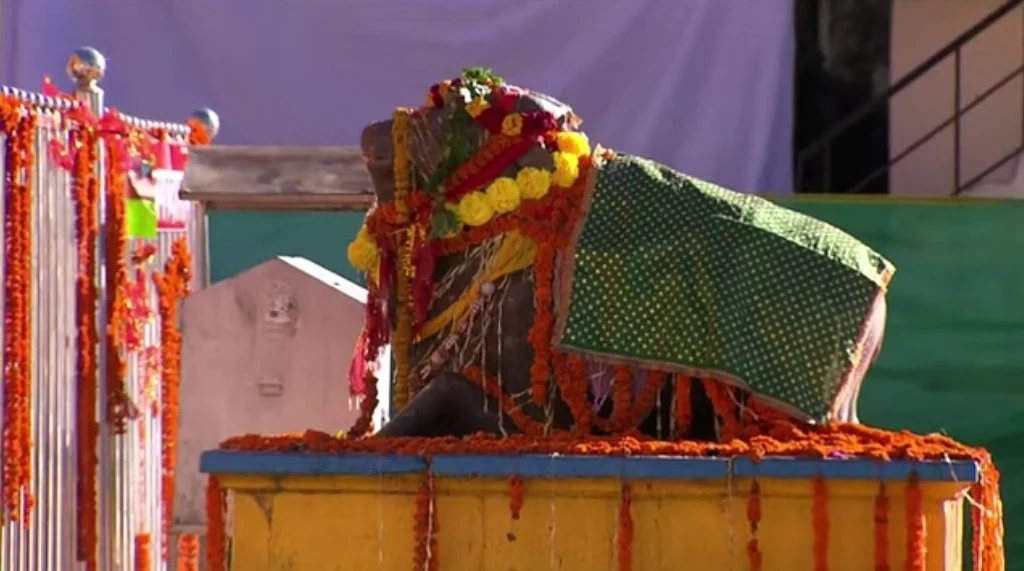
A naturally shaped conical rock inside the temple is worshipped as Lord Shiva in his Sadashiva form. Outside the temple door, a large statue of Nandi (The sacred bull, the vahana and gatekeeper of Lord Shiva) stands as guard. Builders and devotees have continually renovated the temple over the centuries
Myth behind Kedarnath Temple
According to legend, after winning the Kurukshetra war against the Kauravas, the Pandavas felt guilty for killing their own relatives. They wanted Lord Shiva’s blessings to free themselves from this sin. However, Lord Shiva avoided them and finally took refuge at Kedarnath in the form of a buffalo.
When the Pandavas found him, Lord Shiva transformed as a bull and dived into the ground, leaving his hump visible at Kedarnath. The other parts of his body appeared in four different places — his arms at Tungnath, his face at Rudranath, his belly at Madmaheshwar, and his hair with head at Kalpeshwar. Devotees call these five temples — Kedarnath, Tungnath, Rudranath, Madmaheshwar, and Kalpeshwar — the Panch Kedar, which means “five Kedars” in Sanskrit.
History of Kedarnath Temple
Historians do not know who built the original Kedarnath Temple or when they built it. The name “Kedarnath” means “Lord of the Field,” derived from the Sanskrit words kedara (field) and natha (lord). The text Kashi Kedara Mahatmya calls the place Kedarnath because “the crop of liberation” grows here.
The Skanda Purana mentions Kedarnath for the first time and describes the origin of the Ganges River. It says that Lord Shiva released the holy water from his matted hair at Kedara (Kedarnath).
According to some ancient texts like Madhava’s Sankshepa-Shankara-Vijaya, the great 8th-century philosopher Adi Shankaracharya passed away in the mountains near Kedarnath. However, other texts, such as Anandagiri’s Prachina-Shankara-Vijaya, claim that he died in Kanchipuram. The remains of a monument believed to mark his death site still stand near Kedarnath.
By the 12th century, Kedarnath had already become a well-known pilgrimage center, as mentioned in Kritya-Kalpataru, written by Bhatta Lakshmidhara, a minister of the Gahadavala dynasty. Adi Shankara revived the Kedarnath Temple, along with Badrinath and other sacred temples in Uttarakhand, before he attained Mahasamadhi at Kedarnath.
Little Ice Age Burial:
Snow buried the temple for about 400 years during the Little Ice Age (1300–1900 AD), and people later uncovered it
2013 Flash Flood:
The 2013 flash floods severely damaged the temple, and authorities have since reconstructed the area.
Architecture of Kedarnath Temple
Builders constructed the Kedarnath Temple using large grey stone slabs, interlocking them without mortar — a characteristic feature of the North Indian Nagara style. The temple stands on a rectangular platform and includes a main assembly hall (mandap) and an inner sanctum (garbha griha) that houses a naturally shaped conical rock, worshipped as the Sadashiva Jyotirlingam. A large statue of Nandi, Lord Shiva’s sacred bull, guards the temple outside, while artisans have decorated the inner walls with carvings of deities and scenes from mythology.
The temple divides into two main parts:
- Garbha Griha: The sanctum sanctorum, which houses the main Jyotirlingam in the form of a large, conical rock.
- Mandap: A main assembly hall in front of the sanctum where pilgrims gather.
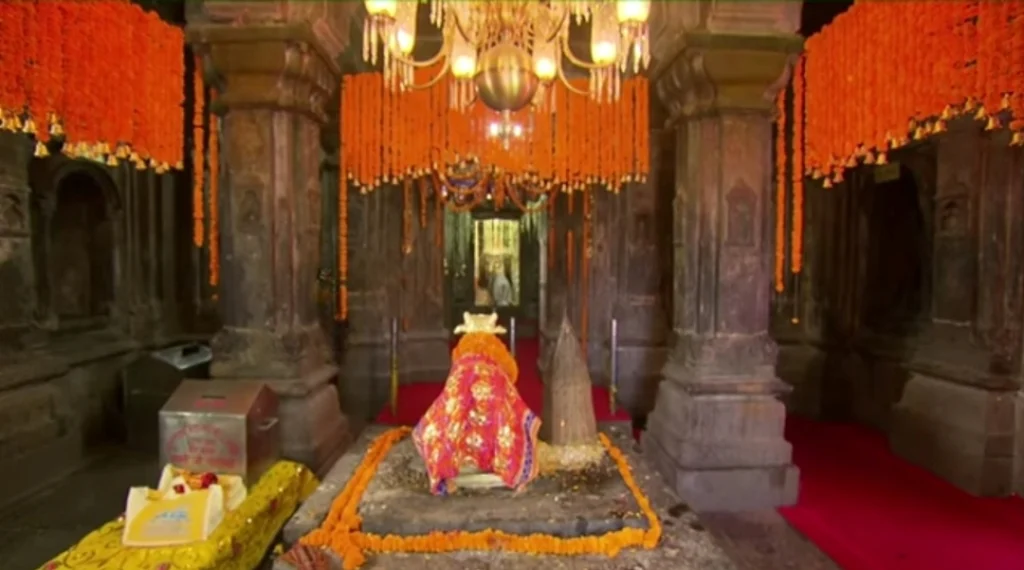
The first hall of the Kedarnath Temple has statues of the five Pandava brothers, Lord Krishna, Nandi (the vehicle of Lord Shiva), and Virabhadra, one of Shiva’s guards. The main hall also has idols of Draupadi and other deities. A unique feature of the temple is the head of a man carved into the triangular stone lingam. A similar carving can be seen in another nearby temple built at the place where Lord Shiva and Goddess Parvati were married.
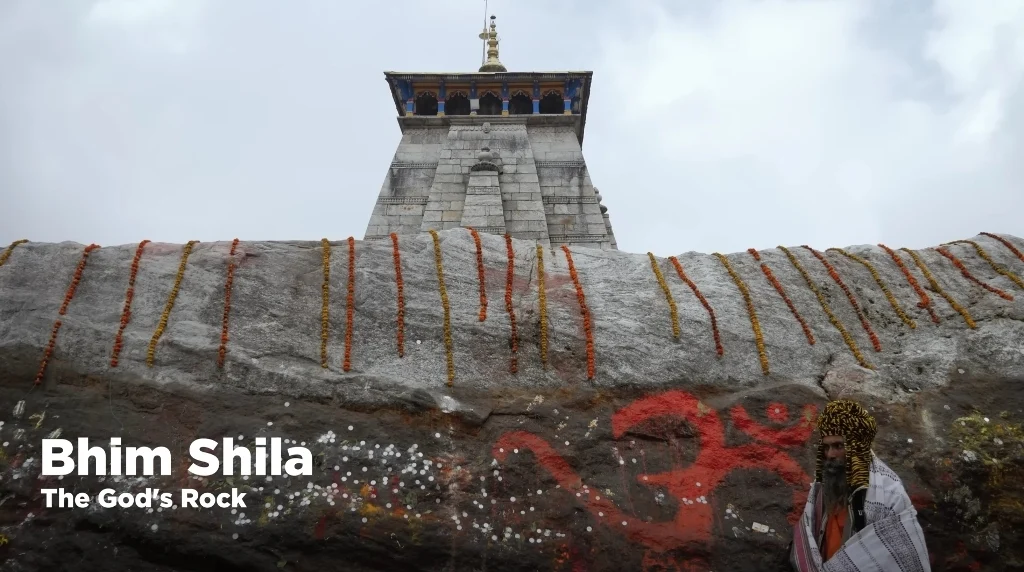
A large rock called Bheem Shila stands behind the temple and is believed to have diverted the rushing water, protecting the shrine during the 2013 floods.
Geographical Location
Kedarnath Temple stands on the banks of the Mandakini River in Rudraprayag district of Uttarakhand at an altitude of 3,584 meters above sea level. To check current Weather click here
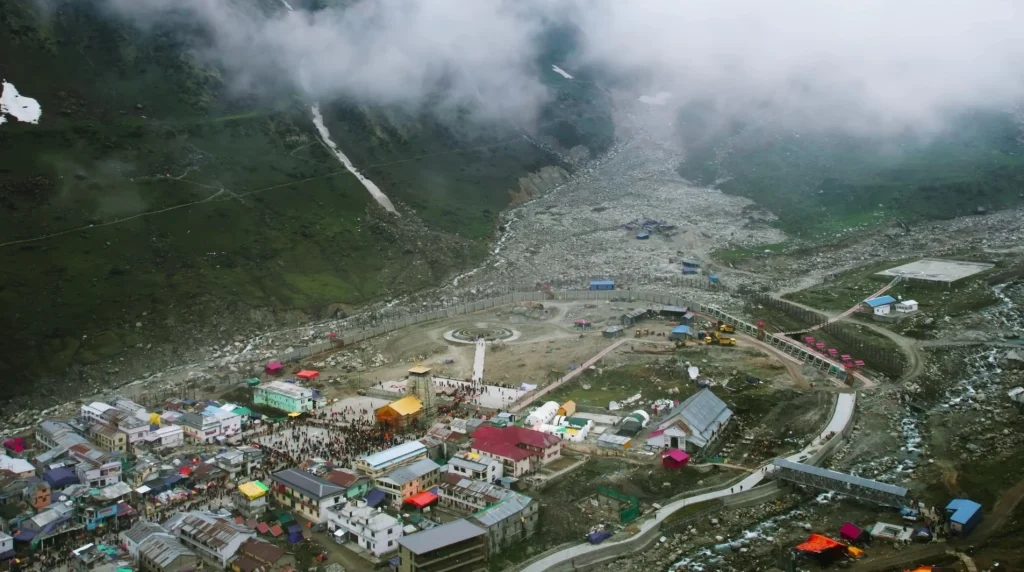
Here’s a quick overview:
| Aspect | Details |
|---|---|
| Coordinates | 30°44′6.7″N 79°4′0.9″E |
| State | Uttarakhand |
| District | Rudraprayag |
| Elevation | ~3,584 meters above sea level |
| River | Mandakini |
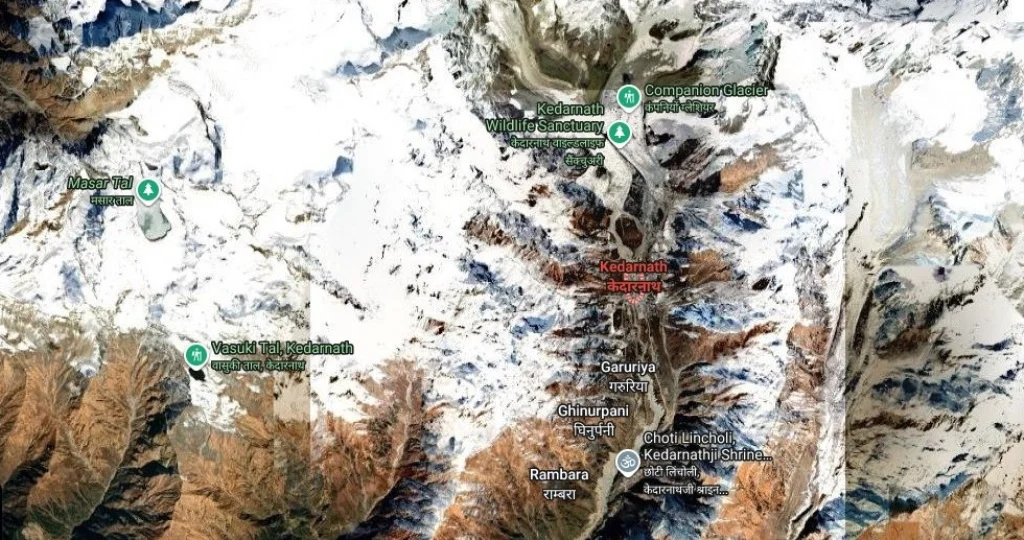
How to Reach Kedarnath Temple

- By Air: Jolly Grant Airport, located about 35 km from Dehradun, is the nearest airport to Kedarnath, situated around 235 km away. The airport has daily flights connecting it to Delhi. Gaurikund, the base for the Kedarnath trek, connects to Jolly Grant Airport by motorable roads, and taxis are readily available for the journey.
- Helicopter services: Operators run helicopter services to Kedarnath from helipads in Phata, Sersi, and Guptkashi, charging tentative round-trip fares of about ₹5,500 to ₹7,740 per person depending on the starting point. Pilgrims can book tickets through the official IRCTC Heli Yatra website to avoid fraudulent sites, and they must complete advance registration for the Yatra. Check out a recent scam shared on reddit.
- By Rail: The nearest railway station to Gaurikund is Rishikesh, located about 243 km away on NH58. Rishikesh connects to major cities across India by train, with frequent services available to the station. Gaurikund is easily accessible from Rishikesh by motorable roads, with taxis and buses available from Rishikesh, Srinagar, Rudraprayag, Tehri, and other nearby towns.
- By Road: Motorable roads connect Gaurikund to major destinations across Uttarakhand. Buses to Haridwar, Rishikesh, and Srinagar are available from ISBT Kashmiri Gate, New Delhi. From key towns in Uttarakhand like Dehradun, Haridwar, Rishikesh, Pauri, Rudraprayag, and Tehri, both buses and taxis are easily available to Gaurikund. The town connects to Ghaziabad via National Highway 58.
- From Gaurikund to Kedarnath: The trek from Gaurikund to the temple is about 16-18 km and takes around 5-8 hours. Alternatively you can hire ponies or mules for the trek.
Accommodation options at Kedarnath

Several accommodation options are available at Shri Kedarnath and nearby areas. Pilgrims can find dharamshalas run by various organizations at nominal charges.
Since Shri Kedarnath Dham is located at a high altitude, many pilgrims prefer to stay in nearby places and complete their Kedarnath Darshan in a single-day trip by helicopter or pony.
- Sitapur (near Sonprayag, about 20 km from Kedarnath): Private hotels are available here.
- BKTC Guest Houses at Sonprayag and Guptkashi: Comfortable guest houses are available at both Sonprayag and Guptkashi for pilgrims. Official link for booking.
Best Time to Visit Kedarnath
The best time to visit Kedarnath is from May to June and September to October, when the weather is pleasant, roads are open, and the skies are clear. The temple remains closed from November to April because of heavy snowfall. It is not advisable to visit during the monsoon season (July to August) due to the high risk of landslides.
Rituals at Kedarnath Temple
The Veerashaiva community from Karnataka appoints the head priest (Raval) of the Kedarnath Temple. However, unlike in the Badrinath Temple, the Raval does not perform the pujas himself. Instead, his assistants carry out the rituals under his instructions.
During the winter season, the Raval accompanies the deity to Ukhimath. Five main priests serve the temple, and each one takes turns as the head priest for a year.
Many symbols of the Pandavas surround Kedarnath. Raja Pandu died at Pandukeshwar, and the locals here perform a dance called “Pandav Lila”.
Festivals at Kedarnath Temple
The major festivals celebrated at Kedarnath include the followng:
- Kedarnath Kapat Opening Ceremony: It marks the reopening of the temple after winter. The temple authorities opened the Kedarnath Temple for the pilgrimage season on May 2, 2025, at 7:00 AM. They closed the doors for the winter on October 23, 2025. For 2026, they have set April 24 as the tentative opening date, and they will announce the exact date on Mahashivratri.
- Vinayak Chaturthi: Devotees celebrate Vinayak Chaturthi at Kedarnath by offering prayers to Lord Ganesha, the son of Lord Shiva. During this festival, which usually falls in September or October, worshippers visit the Kedarnath Temple to seek blessings for happiness and prosperity. They mark the celebration with chanting, rituals, and deep devotion, even though the temple remains closed in winter.
- Shravani Annakut Mela: Devotees celebrate the Shravani Annakoot Mela a day before Raksha Bandhan at Kedarnath and other Shiva temples to mark the new harvest. During the event, pilgrims offer freshly harvested grains to Lord Shiva’s Jyotirlinga, and temple authorities keep the doors open overnight for darshan. At other temples, such as the Vishwanath Temple in Guptkashi and the Kaleshwar Temple in Ukhimath, priests coat the lingam with grains like rice, jangora, and koni.
- Badri-Kedar Utsav: People celebrate the Badri-Kedar Utsav for eight days in June at the Badrinath and Kedarnath shrines in Uttarakhand, India. The festival blends religious rituals with cultural performances and features renowned artists, singers, dancers, and painters from across the country and region. It aims to give pilgrims and visitors a deeper understanding of Himalayan culture and traditions while honoring Lord Vishnu at Badrinath and Lord Shiva at Kedarnath.
In and around Kedarnath
Nearby attractions to the Kedarnath Temple include:
Adi Shankaracharya Samadhi
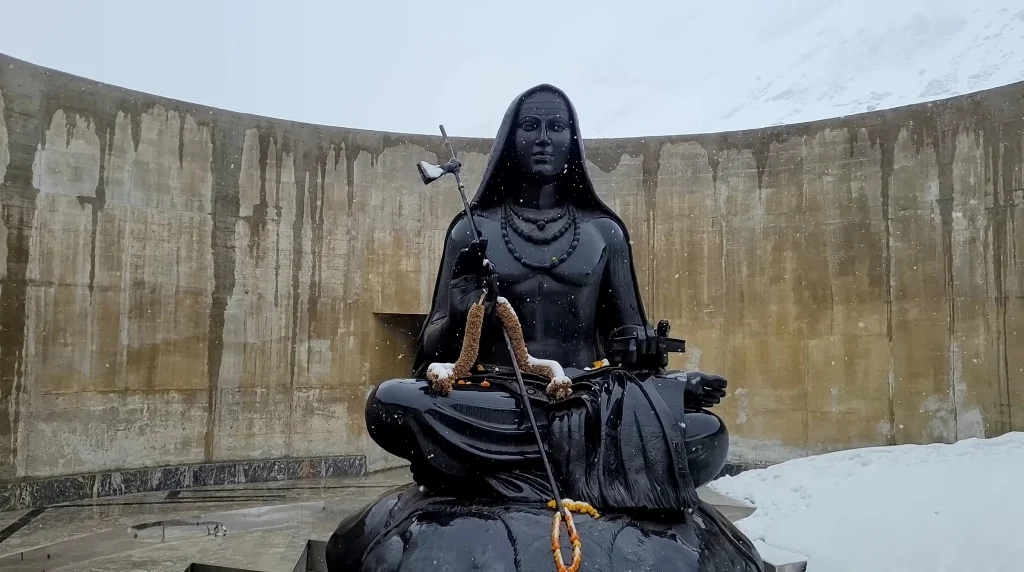
The site marks the place where Adi Shankaracharya, the 8th-century philosopher, attained Mahasamadhi at the age of 32 after completing his spiritual mission of establishing the four sacred dhams. It stands behind the main Kedarnath Temple. The authorities built the current structure to replace the original one damaged in the 2013 floods, and pilgrims visit it to honor his legacy and the philosophy of Advaita Vedanta.
Bhairav Nath Temple
Devotees worship Lord Bhairav, a fierce manifestation of Lord Shiva, at the Bhairav Nath Temple in Kedarnath, located about 1.5 kilometers from the main Kedarnath Temple. They regard Lord Bhairav as the Kshetrapal, or guardian deity, who protects the valley during winter when heavy snow forces the closure of the main temple. Pilgrims traditionally consider a visit to this temple an essential and concluding part of the Kedarnath pilgrimage.
Vasuki Tal
A high-altitude glacial lake located about 8 kilometers north of the Kedarnath Temple in Uttarakhand, India, sits at an elevation of 4,135 meters (14,200 feet). Majestic mountains surround the lake, offering breathtaking views of the Chaukhamba peaks and showcasing rare Brahma Kamal flowers. Devotees consider the lake sacred because legend says Lord Vishnu bathed there. Trekkers and spiritual seekers find the journey challenging yet rewarding, and experts strongly recommend hiring a guide.
Gandhi Sarovar
Gandhi Sarovar, also known as Chorabari Tal, lies about 3.5 to 4 kilometers from the Kedarnath Temple in Uttarakhand, India. Trekkers visit this glacial lake frequently, which was named after Mahatma Gandhi, whose ashes were immersed in it in 1948. Devotees regard the area as holy because legend says Lord Shiva taught yoga to the Saptrishis here. The lake sits at an altitude of about 3,900 meters (12,800 feet) and receives its water from the melting snow of the Chorabari Glacier.
Gaurikund
A Hindu pilgrimage site and the base camp for the trek to Kedarnath Temple in Uttarakhand, India, stands at an altitude of 6,502 feet above sea level in the Garhwal Himalayas. The site is associated with Goddess Parvati, also known as Gauri, the consort of Lord Shiva. According to Hindu folklore, Gauri performed intense penance through ascetic and yogic practices to win Shiva’s love. Local tradition states that Gauri lived at Gauri Kund while carrying out these practices, and here Shiva finally confessed his love for her. The two were later married at Triyuginarayan, located nearby. Natural hot springs in Gauri Kund have been developed into bathing places for pilgrims.
Sonprayag
A village in the Rudraprayag district of Uttarakhand, India, lies about 73 kilometers from Rudraprayag town, the district headquarters. The name Prayag means confluence, and Sonprayag stands at the meeting point of two holy rivers, Basuki and Mandakini. Pilgrims commonly use the village as a rest stop on their way to Kedarnath.
Kedarnath Trek
The Kedarnath trek lies inside the Kedarnath Wildlife Sanctuary. It covers a 16 km route from Gaurikund to the Kedarnath Temple and is the most popular trail here. The path passes through forested mountains, glaciers, and many small waterfalls. The trek is moderately difficult, with some steep sections.
The trek is open from 4:00 am to 1:30 pm, matching the sanctuary’s visiting hours. An additional 800-meter uphill trek from Kedarnath leads to the Bhairavnath Temple (Bhairon Baba Mandir), which offers breathtaking views of the Kedarnath Temple and the lush green valley below. From Kedarnath, trekkers can also continue to Chandrashila, a beautiful summit located about 32 km away.
You can also enjoy the region’s natural beauty by camping near Kedarnath town. Spend the night surrounded by divine vibes, with the majestic Kedarnath peak towering above and a sky full of shining stars.
Conclusion: A Journey Beyond Faith
Visiting Kedarnath is not just a pilgrimage — it’s a spiritual awakening. Settled high in the Himalayas, surrounded by snow-clad peaks and the sacred Mandakini River, this divine temple of Lord Shiva stands as a timeless symbol of faith, devotion, and endurance. Every step on the path to Kedarnath feels like a conversation with the divine — testing your will, purifying your spirit, and rewarding you with peace beyond words.
🙏 Har Har Mahadev!
Frequently Asked Questions (FAQs)
It is believed that wherever Lord Vishnu steps, Lord Shiva resides nearby. The Char Dhams follow this tradition. Therefore, Kedarnath pairs with Badrinath, Rama Setu pairs with Rameswaram, and Somnath pairs with Dwaraka.
Kedarnath stands as a highly sacred Hindu pilgrimage site, dedicated to Lord Shiva, one of the twelve Jyotirlingas, and forms a key part of the Char Dham Yatra.
A budget-friendly Kedarnath trip can cost roughly ₹7,000 to ₹15,000 per person, covering basic train/bus travel, budget stays, and simple food, while mid-range and luxury trips can range from ₹20,000 to over ₹60,000 due to flights, hotels, and helicopter services.
The cost for a Kedarnath helicopter service varies by departure point, with options from Guptkashi, Phata, and Sersi. Round-trip fares are approximately ₹8,533 from Guptkashi, and around ₹6,063 to ₹6,061 from Phata and Sersi, respectively. Booking is done online through the official IRCTC portal and requires user registration.
To get VIP darshan at Kedarnath, pilgrims must book online through the official Badri-Kedarnath temple website.